Tuesday, March 7, 2017

SANCTITY OF LIFE

Can one support the death penalty and in the same breath claim to preserve the sanctity of life?

I don’t expect any disagreement if I say, humans are different from animals in that we possess an ‘awareness’ (‘sentient’ is the term often used to describe this sense of awareness, many refer to it as ‘reason’) that places us at a higher plane of existence than animals. As much as Trooper, my French Bulldog, is as smart a dog as he can be and is an enjoyable company because of his affinity and loyalty to me, he would not have the level of ‘awareness’ that a fellow human being would have no matter how dumb that individual may be.

The sense of awareness that we all have as human beings, which I wouldn’t hesitate to call, Soul, is what endows us with the sanctity of life. Being human has the benefit of the sanctity of life. Reading this, if you’re a Christian, may cause you to reel in your pants right now because you would say that the image of God and the fact that we’re created by God, and nothing else, give life the character of holiness or sanctity! You may even be starting to cite Bible verses here. Relax! I’m talking of the same thing. I was trying to simplify it, but now you have made we write more sentences just to assuage your religious sensitivities. Jeesh!

Where was I before I was rudely interrupted?

The soul is what marks us out from animals. And it is important for us to see every human being as having the sanctity of life to avoid treating others or being treated ourselves like animals.

Killing another human being (without valid reason, like self-defense) is beyond the pale as it violates the sanctity of life that we all want to preserve. But does killing another human being make the killer lose his own (let’s just say the bad guy is male) sanctity of life?

According to supporters of the death penalty, when somebody kills another human being the killer, in turn, needs to be killed as punishment to preserve the sanctity of life. They would say, too, that punishment of the killer and compensation to the victim must be in kind. It would seem that anything short would not be enough recompense for the life taken away.

For the supporters of the death penalty sanctity of life is only good until one person takes the life of another human being. Killers can be killed because they have, presumably, lost all claims to being human by taking away the life of another person.

Here are my problems with this thinking:

How is the sanctity of life preserved when another human life is taken by the death penalty? It is totally absurd to say that killing the killer preserves the human need to promote and preserve the sanctity of life. Let’s grant that the killing of the original victim violates his sanctity of life. But if we’re going to be consistent about it, doesn’t the killing of the killer also violate the sanctity of life of the killer as a human being?

The death penalty does one thing. It accepts the notion that some of us who have taken the life of another have become sub-humans and thus have lost any claim to the sanctity of life and can now, in turn, be killed without consequences. This is the only way that the death penalty can be meted out without decimating the sanctity of life, that is, killers need to be turned into sub-humans to remove their right to life.

Supporters of the death penalty would like society to have the prerogative to be able to reclassify killers from human beings to animals, which is the only way the death penalty can be justified without conceding that such punishment also violates the sanctity of life.

But nobody can really turn off the humanity of a person, no matter how heinous his action has been. A mango will always be a mango even if turns rotten. You may not want to eat a rotten mango, but, sorry, it remains a mango despite your feelings about it.

Holding on to the sanctity of life and at the same time supporting the death penalty doesn’t make sense, unless we make some arbitrary decision that those who have killed another human being have descended, by some dint of fiction, into a sub-human state. And who is to make this decision that a guilty person has passed into an animal state? The justice system that everybody concedes is flawed? Imposing the death penalty is humans playing God, and flawed humans at that!

There is danger in accepting the idea that we can arbitrarily switch off a man’s (let’s just stick with males this time) innate nature, or, as I described it, soul, and turn him into an animal because he has killed another person.

This is a slippery slope because if we give in to our penchant to dehumanize others who we feel are undeserving, where do we stop?

Many supporters of the death penalty would also take away the sanctity of life of, aside from killers, rapists, drug pushers, plunderers, even if there are no lives lost in these crimes no matter how dastardly they may be. This is not a hypothetical situation because we have seen this before in Europe, Rwanda, Srebrenica and elsewhere where genocide was committed against millions of people just because they belong to a certain race.

We don’t even have to wander far in geography and history. In this country, the Philippines, we are being told that people connected with illegal drugs are not humans and can be disposed of at will if they resist arrest or by vigilante groups, who are, as reports would have it, also run by the police.

The death penalty is also a final act where no rehabilitation or redemption is even allowed for those who have committed a grievous mistake against the society but have seen the errors of their ways. Everybody should be given a chance at rehabilitation and redemption even if they need to be incarcerated for the rest of their productive lives. Further, because of the imperfect justice system the death penalty doesn’t allow mistakes in the system to be rectified. That many innocent people have died by capital punishment because of the flawed system should give us a pause about imposing the death penalty.

Why do we lust for blood when we can punish killers and others in a manner that would preserve our humanity? The death penalty is a serious threat to the sanctity of life of us all.

Even assuming that we can re-classify killers as animals, sub-humans are not necessarily less deserving of life. We just don’t kill animals even for food. We treat them humanely providing them legal protection against cruelty. Under the law, the animals we eat are limited to certain species. Eating animals outside of the list is liable for the crime of cruelty to animals. Vegans would even assert that all killings of animals are cruel. Our societies acknowledge now that sub-human species also deserve to live.

The elephant in the room is in everybody’s mind that may be familiar with the violent story of the God of the Old Testament. If the death penalty is so bad, why would God impose it? And he imposed it on the most trivial of offenses, like violating the Sabbath (Exodus 35:2) or children dishonoring their parents (Exodus 21:17).

This is a good question and would require a full treatment elsewhere. But suffice it to say that God in the Old Testament is intent in preserving a nation to accomplish his plan of redeeming and claiming back his creation that has gone astray. There are plenty of sick things that happened in the Old Testament in the process of God going about his plan that are hard to explain, and his seeming penchant for violence is one of them.

Here is another one. Jesus came from the family of David who came through the lineage of Perez (Matthew 1) who, in turn, was born from the incestuous relationship via prostitution between Judah and his daughter-in-law, Tamar (Genesis 28). The Savior of the world was born from a scandalous situation in the Old Testament. Does that mean that incest and prostitution are not really evil because God seemed to have employed them in bringing forth the Messiah through the nation of Israel? You can make your own conclusions.

The point, however, is that the violence of God, including his seeming penchant for killing people (remember the genocide and infanticide he ordered in Deuteronomy 7) in the Old Testament is hard to explain. There are books that have attempted to do so. But one cannot champion the death penalty “because God has done so” but gloss over the other violent things that God has also done in the Old Testament. Those who support the death penalty on the basis of God’s explicit commands to his chosen people in the Old Testament cannot also be selective on the crimes that they think deserve the death penalty. God has commanded capital punishment on many offenses and supporters of the death penalty on the basis of the Old Testament cannot just pick and choose from the offenses that God said the death penalty should be imposed. If you propose that God is pro-death penalty, then you should stand with him all the way!

The Old Testament and its literal reading can easily turn our brains into a pretzel. But the good thing is that Jesus has clarified all this in his life, death and resurrection. He is the full manifestation of God and God’s mouthpiece in our time (Hebrews 1:1-3).

Jesus has raised love as the foundation of the Christian faith. He told Christians to imitate him and love their enemies even to the point of death (Ephesians 5:1-2)! It is hard to say we’re following Jesus if we agree to kill anyone, even if they have made grievous mistakes, including the killing of another human being. Jesus must filter everything we read in the Bible, particularly the Old Testament. Not all that we read in the Bible has equal value. This is a mouthful to say, but it is true. Jesus should be the final filter of our reading of the Bible. It would be hard to operationalize what Jesus said and how he lived and treated others, like his lesson on loving enemies, by supporting the death penalty. There is no clearer definition of an enemy than somebody who has disrupted our society by killing another person and from whom we all have to be protected, and who we can easily dismiss as an animal. Jesus enjoins us to love that dastardly fellow, not kill him!

Jesus is the ultimate champion for the sanctity of life of all human beings even if society feels like treating some of us as less than humans and would deserve the death penalty.


Sunday, January 8, 2017

We need to support Human Rights for all!

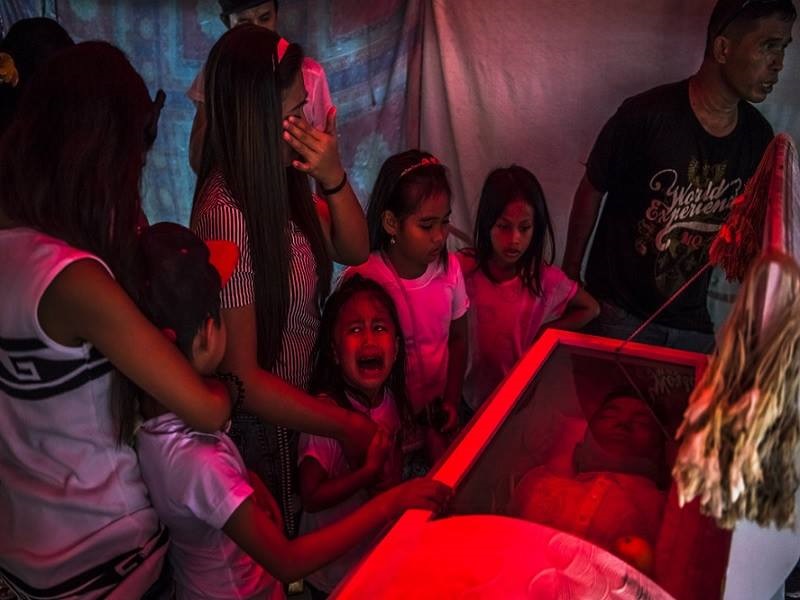
A child cries beside the coffin of her father,
who is alleged victim of drug-related killing.
Photo by Daniel Berehulak/NYTimes
I heard it again the other day. 

Someone pointedly asked somebody, who has expressed disgust over extra judicial killings, “Why are you more concerned about the human rights of addicts and pushers than the human rights of their victims?”

If you’re concerned over EJKs and have expressed misgivings about how the government of Mr. Duterte is conducting the War on Drugs, you might have been asked this question or have seen it posted on Facebook and the question could have, for a minute, stopped you on your tracks.

Well, don’t be!

First of all, this question assumes a false dichotomy making us choose between two perfectly valid and congruent propositions: on the one hand, the human rights of the EJK victims, and on the other, the human rights of victims of crimes committed by drug addicts and pushers.

Don’t accept the dichotomy! None exists because these two propositions are not contradictory or mutually exclusive. We should all be concerned about the human rights of all people. So, don’t let that question trap you, just reject it as a fallacy!

Reject also the false assumption that by speaking against EJKs you are less concerned about the human rights of victims. That shouldn’t be necessarily true as I’m sure all of us would like the justice system to work for all crime victims. Who wouldn’t want police officers, prosecutors and judges to do their job and rid our communities of crimes and criminals? We all do and those who would say otherwise are making an unwarranted presumption against us.

“If what you say is true,” you might ask, “why do many people speak of human rights only of EJK victims and remain silent on the human rights of crime victims?”

This question is a close cousin of the first question we discussed above. This second question represents a technique, called ‘red herring,’ which tries to divert attention from the issue at hand by bringing up a totally different matter that may not have real connection to the original issue. The idea is to create diversion and confusion and avoid tackling head on the matter at hand.

This diversionary technique is often used in detective stories to create suspense and excitement on the final outcome of the story. If you’re married or have ever been in a relationship, I’m sure that you’ve employed this technique at least once to divert the discussion from a topic where you are losing to your partner by raising a different issue. Come on, admit it!

If the issue at hand is EJKs, why bring up the matter of the purported rights of the victims of druggies? Justice for crime victims is an important issue, but it shouldn’t deflect attention from the discussions on EJKs. In other words, even if druggies commit heinous crimes, and only some and not all of them have done so, the question of attaining justice for their victims is not a valid justification for the violation of the human rights of the suspects or accused. Offenders are entitled to due process as much as their victims are entitled to justice and compensation for the damages inflicted on them. Each issue occupies a side of the same coin.

Secondly, it would be an unwarranted generalization to speak of “victims of drug addicts and pushers” because not all of them have committed heinous crimes or have victimized others to support, or as a result of, their involvement in illegal drugs.

For sure, some drug addicts and pushers have committed grave atrocities. But there is no data to show that ALL 6,000 plus killed over the last six months on drug-related cases have actually committed heinous crimes.

How many among the EJK victims were also wanted by the police for murder, rape, robbery, or other atrocities? Many of these victims did not have any standing warrants for any heinous crime.

Many people applaud the death of every EJK victim falsely equating each death as the demise of a murderer, rapist, robber or other type of criminals. Not all EJK victims were heinous criminals, and it is absurd to lump them all up under this category.

In fact, the vast majority of EJK victims appeared to be poor. They might have been involved in illegal drugs but they were not heinous criminals. And this War on Drugs so far has been directed at poor communities. Have you heard of EJKs in posh villages where many big drug laboratories had been discovered in the past and many prominent residents had been arrested as drug pushers? None!

But, again, you might ask, “Shouldn’t we be concerned about the victims of crimes committed by druggies even if not all EJK deaths represent the demise of heinous criminals?”

For sure, we should be concerned about victims of heinous crimes whether or not committed by drug addicts or pushers!

We will not and cannot abandon the human rights of victims. This is beyond question!

But here is what we should keep in mind when this subject comes up.

The entire justice system (law enforcement, prosecution, judicial trial and appeals, correction and penalties) is geared towards the protection of the rights of victims, to compensate their loss and redress grievances, and to penalize offenders.

We call this the Rule of Law, which is to say that there is due process in getting criminals off the streets, making them pay for the damages they have caused, and ensuring that convicted criminals serve appropriate jail time and/or pay fines. This can be complicated at times. But all this legal rigmarole is intended to achieve justice for crime victims. Justice for crime victims is non-negotiable if we are to ensure quality of life and peace and progress in our communities.

Justice for victims also arrests impunity. We want all criminals brought to justice so that none of us is ever victimized by them again. This is the ideal we pursue even if it is unrealistic to fully obtain.

But we want to make certain in rounding up criminals who are causing harm in our neighborhoods that we do so with appropriate legal safeguards against would-be despots, who would abuse power in their hands by oppressing the weak and vulnerable. We also cannot allow mob rule and street justice as we want to protect the rights of the poor and the powerless. The manner by which we defend the rights of those in the margins of our communities is the standard by which we measure our flourishing as society. The Rule of Law and due process shield against the depredation of the weak by the powerful among us.

While the Rule of Law seeks justice for crime victims, such “justice” would be hollow if we don’t include under such rules the fair treatment of suspects and accused by requiring proof of their guilt beyond reasonable doubt by a corrupt-free justice system. The basic demand of fairness is that not one party should act as the prosecutor, judge and executioner. The convergence of these three different functions into one party embodies what is so detestable about EJKs.

Unless we carefully adhere to the demand of fairness, the law of the jungle would take over where the most powerful rules without restraint and the rest carries the weight of oppression.

“Our justice system is broken,” you might say, “impunity happens, and criminals get away with murder! Why don’t we just employ the law of the jungle and kill all the druggies?”

If the justice system is broken, the solution is to fix it and not to ditch the Rule of Law and due process. If our front door is broken the correct solution is to fix it and not get rid of the door altogether leaving the occupants more vulnerable and exposed.

The same is true if we applaud the killing of suspected criminals without due process of law. The evil that we think we prevent by killing criminals outside of the Rule of Law is merely replaced by the evil we perpetuate in killing them. Such “justice” is a mirage and will not quench our thirst for peace and safety.

The Rule of Law stops the cycle of violence that threatens the existence of our society. And punctiliously adhering to it despite the temptation to short-cut the process assures us of a more secure, just and peaceful future. Without the Rule of Law, predators win hands down all the time! When you’re tempted to ditch the Rule of Law, think again, as you might need its protection someday.

The rights of victims and the rights of suspects and accused from unjust punishment, including those that we consider the scum of society, are like two legs that help us tread the path of a just and progressive society. When anybody foolishly tries to cut-off one leg in favor of the other, it cripples justice and no one can be really safe anymore.

Wednesday, December 28, 2016

FORGIVE

That word punctuates the vocabulary of many today who believe that the atrocities during the Marcos dictatorship should just be forgotten.

“Move on!” is the twin partner of the hideous advice for Martial Law victims to suck it up and live with the traumas of the past.

“Forgive” and “Move on” are words used now as a blunt instrument to suppress protests against the burial as national hero of Marcos, the ousted dictator, offender to Martial Law victims, head honcho of global-scale cronyism, ignominious despot, and disgraced liar!

It would be disingenuous to say that Marcos was buried at the Libingan ng mga Bayani merely as former President and soldier, two lofty positions that he dishonored with abuse and corruption.

Libingan is symbolic of honor and highest esteem for those who valiantly and selflessly served country and people ahead of oneself, the definition of heroism.
Marcos’s burial at Libingan is no ordinary event that merely inters a former President and solider. It was meant to make him a hero and thus rehabilitate his place in history by its blatant revisionism.

Marcos doesn’t deserve this honor. It is vainglorious for his family to believe that history would be kind in judging their discredited kin.

But they get help from those (especially Christians) that now demand forgiveness, in the name of healing and reconciliation, from Martial Law victims and the nation as a whole that the dictatorship also victimized.

They take inspiration from many admonitions in the Bible to forgive.

If Christ forgave those who killed him, how can we not do the same to a despicable despot, like Marcos?

Not mentioned in this counsel is the wile and scheme that while we are busy forgiving they will also bury him as a hero!

It is true that Jesus called on his followers to forgive. It is a radical demand with which we cannot trifle.

It would be important to see its application for Christ’s followers amid the chaos of the country we are in.

Forgiveness is to take upon our own account the wrong committed by others against us. We don’t retaliate against an offender. We offer the other cheek, if we get slapped on the other. We don’t return the pain inflicted on us by our enemies.

The biblical admonition to forgive allows for the highest expression of love.

We love others to the point of death in imitation of Christ’s ultimate show of love by accepting the violence of the cross. His death took upon his own account the sins of others.

The admonition to forgive is addressed to us to extend grace to those who have offended us. It’s a call for us to wrestle with the demand of love through forgiveness when we are the victims.

And this is key: the admonition is directed to us. We cannot pontificate on forgiveness by demanding others to forgive and avoid directing the admonition to ourselves.

Even if we have extended forgiveness already, we avoid pouncing on the heads of those who haven’t. To do so would be arrogant, sanctimonious, and judgmental of those whose shoes we don’t walk on.

We should not use the call to forgive as a political instrument to silence the expression of pain, and even of protest, of those that have been victimized and whose grievances have yet to be redressed.

Society cannot moralize on forgiveness and at the same time countenance victimhood without paying a price.

Injustice must be redressed that’s why we have structures like Rule of Law to prevent abuse and impunity.

Without justice and accountability for the victims, our society will not be aright and we will all be losers for it.

Righteousness (or, justice, if you will) is the end goal. Our collective pursuit of that goal is declaration that despots would never ever be welcomed in our midst—much more be treated as hero—to again inflict harm on the country.

To attain righteousness, forgiveness is merely one side of the equation. Righteousness requires not only forgiveness from the victims. Its other pillar is contrition by the offender.

Forgiveness and contrition lead to justice. Without one or the other, healing and restoration will not occur.

Restorative justice requires both elements. Much like in case of marital abuse, healing and restoration will elude a marriage if the abuse remains even if the victim forgives the abuser.

Those who call on the victims to forgive the atrocities of the Marcos dictatorship should equally demand contrition from the offender.

While he is already dead, his family and heirs can do much to amend the wrongs he committed. (By the way, his minions should also be made to account.) They can start by returning his loot and redressing the grievances of the disappeared and tortured during Martial Law.

For our society to flourish, righteousness should reign.

To achieve righteousness, we should call on all sides to do what is required of them: for the victims to forgive, and for the offenders to show contrition and offer reparation for the damages they have caused.

To call on the victims to forgive but allow offenders to go scot free, and even to be buried as hero, is to perpetuate evil and promote impunity and injustice.
When we have achieved both forgiveness and contrition, then we move on.


Monday, December 5, 2016

SICK CHRISTIANITY

Michael Brown, an unarmed black teenager, was shot and killed on August 9, 2014, by a white police officer in Ferguson, Missouri. It set off weeks of protestagainst policing that easily targets black men.

Willie James Jennings, writing in Religion Dispatches in December 2014, after a grand jury decided not to indict the police officer, expressed disgust over Christianity he called “sick” that is at ease with violence in the name of law and order. He said, “Too often, Christians…have given sanctuary to the spirit of fear, commending a form of policing that makes violence a surgeon’s scalpel, imagining our safety in the illusion of its measured use.” He warned that, “Violence knows no measure.”

The Philippine National Police has recently released the number of killed in the Philippine government’s war on drugs from July 1 until December 1, 2016. The number of deaths has totaled to 5,845. Of this number, 2,004 were killed during police operations, and 3,841 are victims of extrajudicial vigilante-style killing. An average of 39 people are killed EVERY DAY over the last five months in drug-related incidents.

These numbers are staggering and have reached the levels we have seen of deaths during the whole duration of martial law. And they are increasing by the day! If the trend continues, at the same time next year we will see about 20,000 people killed in the government’s war on drugs.

The government has hidden behind the “presumption of regularity” in the performance of duties in the police operations that resulted in 2,004 deaths. This has stopped police investigation except for the most egregious cases, like the Espinosa killing inside Leyte’s sub-provincial jail in Baybay. (Even in this case, the President quickly absolved the police officers involved and even admitted having a hand in keeping them in position despite their previous connections to the drug trade.) The rest of the victims in the incidents where the police are not purportedly involved are filed as “Deaths Under Investigation.” Few, if any, have been arrested or indicted in any DUI cases.

If this is not a situation of impunity in our country, I don’t know what is!

As Jennings would say, it would be a sick Christianity if it remains at ease with violence and killings in the name of war on drugs.

Killing is never a Christian value. Violence in the Old Testament (genocide, infanticide, capital punishment, you name it) is turned over by the gospel of love that Jesus propagated and lived by, modeling what it should be like for followers in his Kingdom. Jesus did not come to destroy the law but to fulfill it, which found its achievement by his sacrifice on the cross. The Messiah who died to offer salvation even for his enemies cannot be at ease with the rate of killings we’re seeing today in our country.

Everyone deserves salvation and enjoys equal value in God’s sight no matter how atrocious their life choices have been. We are all created as image bearers of God and object of his eternal love. Because of Christ, we cannot align with any government that diminishes human life, even in the name of law and order.

To kill is not part of the Christian arsenal in our mission to transform communities. We should be in the forefront of defending everyone’s right to live and be changed by God’s love. We should reject the idea that someone has passed the line of incorrigibility and deserves to die. Remember that with God nothing is impossible! The gospel is not meant to condemn and punish, but to restore and heal.

Sick Christianity would gloss over the tough demands of love and would lamely acquiesce to killings in the name of tough law enforcement to lick society’s drug problem even in the absence of credible evidence that such strategy has ever worked anywhere in the world. And at the rate it is bungling its job so far there is no indication at all that the Philippine Government could be the shining exception to the global record of failure of the war on drugs.

Sick Christianity hides behind a (too) narrow reading of Scriptures that purports to mandate that the only form of political engagement available to Christians is, one, ‘to pray’ for the government, and, two, ‘to submit’ (sometimes misread as ‘to obey’) to authorities, based on two or three proof texts written in eras so unlike ours.
Such a reading totally misses the message of the Gospels and Acts, whose core message is a protest to Caesar’s claim that he is king, because he is not. The good news is that Jesus is the true King!

No one is King today, other than Jesus. Our elected government has not attained perfection and will never do so to be spared from criticism and even protest if they do stray and pursue policies and actions opposed to the values of the Kingdom. God’s instituting of governments is meant to preserve the good and curtail evil for the benefit of the people. God’s imprimatur of governments to be instrument of order and the flourishing of humanity does not provide governments and its officials with immunity from being called out for their failures in governance and weakness in character.

Indeed, we should fervently pray for and wisely submit to government. But these critical activities cannot be made to justify our lack of action in allowing evil to continue.


Every killing bleeds the heart of God. Be it committed in Mendiola, Mamasapano, Hacienda Luisita and the war on drugs. If it bleeds the heart of God, it should also bleed ours. Sick Christianity prevents us from such lament. 

Monday, November 7, 2016

TRAUMA

When we see duct-taped corpses thrown in the streets of our neighborhoods almost on a daily basis, its repulsiveness wears off at some point in our consciousness.

These killings everyday have inured us all to its unpleasantness. “It happens!”

Then off we go to where we can nurse our traumas from this violence in our midst.

EJKs or not, the fact is thousands have been killed over the last four months. Even the number of killings that are not reportedly part of police operations still tallies in the thousands.

Indeed, we are in a state of lawlessness!

How are we supposed to deal with all this?

Apparently, with a new category upon which to hook our suspended outrage: “Death Under Investigation.”

DUI—didn’t this use to refer to Driving Under the Influence?

A clear case of oblique deflection, if I see one, to our fears that our country has not yet really attained Singapore-like zone of safety.

It’s like numbing our brains by drinking our problems away. “Don’t worry, these killings are DUI!” 

In our justice system the police would generally wait first for complainants to materialize before doing anything about the crime.

The reality is most aggrieved parties and survivors of the victims in these killings don’t approach the police for various reasons, including the fear that the precinct itself had something to do with the murder. To expect them to go to the police is like asking the rape victim to go back to her rapist for protection. And that would just turn out really well!

“Death Under Investigation” is another way of saying that the crime will never be solved. The police know a murder has been committed but they have no idea how to solve it yet.

This state of affairs is nothing less than a state-sanctioned national trauma. There will be no closure to these killings and we just have to deal with it!

The President has threatened that if things don’t go his way, expect 20 to 30 thousand more killed as a result.

Not sure whether he means the government will do the extra killings, or the killing spree will continue by whoever is committing them now. I’m trying to kick into my creative imagination mode to figure this one out.

The only way I can divine the President’s logic is this: he is threatening that if the killings don’t stop (presumably what he wants), the killings will go on. Brilliant!

Meanwhile, off we go to where we can nurse our traumas from this violence in our midst.

Tuesday, June 1, 2010

NOW

I still remember when I began to daydream. I was adolescent and starting to get bored with my humdrum high school life. I recall unashamedly that I enjoyed levitating my mind to project myself as somebody I fancied—normally the hero or the prince charming of the drama I would play in my head. (Of course, I wouldn’t give up the lead role in my own mental production.)

Recalling this got me thinking how important it is to be fully rooted in the present.

We humans live in segments of space and time. Life is temporal with past, present and future. If we are to learn contentment and to experience joy we need to fully live in the present. We cannot change the past. It is there—an unchangeable reality. The past is not going to happen again. We cannot linger there. We can only gain wisdom from the lessons it teaches.

Among the three facets of time, the future is the most temporal of all. Unlike the past, from our perspective (not God’s) the future is not even a reality. Living in the future is worse than living in the past. It is with respect to the future that the devil’s deception is most strongly directed against us. He wants to snuff contentment in our life and rob us of our joy. And there is no better way of doing that than by pushing us to live in our dreams. He doesn’t want us to relish life that God has given us now. He makes us focus on the future, which leaves our hearts discontented and makes us long to escape the present.

Many of us are camping in our dreams and so miss the blessings of the present. We have succumbed to excessive ambition and drive to succeed and have made the present a springboard to some future dream instead of a stage for enjoying what God has given us. In so doing we allow the present to fly quickly by and thereby miss much of life with our spouse, children, friends, work and, more importantly, God. We are so focused on where we want to end up that we gloss over where we are. The irony is that we never get to where we want to be because there is always somewhere else to go.

I submit that it is in the present where God meets us. It is now that the Holy Spirit is working in our hearts to transform us. It is only in the present where we can experience the joy, peace and love that God offers. God is eternity. The nearest that we could sample eternity in this life is to consider the present. God is in the eternal present. There is no past or future in Him. He deals with us today, not yesterday, not tomorrow. To the extent that we escape the present by either living in the past or, worse, escaping to the future, we will live a shallow and unfulfilled life. There’s nothing wrong with planning for the future, but we must stay rooted in the present. Being faithful and grateful here and now is what it means to forget what is behind and strain toward the goal to which God has called us heavenward.

We know that we’re living in the future when we worry too much about it. Jesus said let tomorrow worry about itself. He said this while pointing to the birds and the flowers. Clearly, as busy as Jesus was he spent time enjoying their beauty. We need to do the same.

Go and smell the followers and watch the birds. And don’t forget to bring your loved ones along. Time flies.

Thursday, April 22, 2010

THE GLORIOUS MARGINS

It's an unpleasant truth to face: the Philippines is a weak state. In fact, the head of a local foreign business chamber, whom I was in conversation recently, has a more brutal outlook. He is convinced that our country is a failed state! It is easy to think that foreigners have nothing but disdain in a culture that they don’t understand. But I must say that hearing this foreigner, who has been a long-time Philippine resident, I am not sure that I could disagree with him.

Failure of Politics
It’s a slight exaggeration, I must admit, but there are glimpses of the country that at times look like Hobbes’ bellum omnium contra omnes (“the war of all against all”). We see this everyday. Criminal justice totters as crime runs rampant. Corruption is endemic both in the public and private sectors. The country’s insurgency runs longest in Asia. Mindanao remains in violent fractiousness despite decades of efforts at peace.

And then there is poverty and the sense of hopelessness among the poor. Government statistics says that twenty-five percent of Filipinos live in poverty. (The situation may be actually bleaker. Some UN data indicate that 46 percent of Filipinos earned less than $2 a day in 2001. It could only be worse today.) But the irony is that we manage every year to include several multi-billionaires (in US dollars terms) in the ranks of richest people in Asia. We are a poor country with scandalously uber-rich people.

The Philippine ship sputters in fulfilling its role as God’s servant to promote good and to punish wrongdoers (Romans 13:4). Our brand of politics has failed the country. The system has not worked and no one seems to know how to right our listing state.

In the midst of darkness and messiness we experience in this country, it is time to call out the church to be faithful to our calling to pray and work for Christ’s Kingdom to come and His will be done on earth as it is in heaven.
Our mission is to spread God’s rule, where God is recognized as truly sovereign not by political or legal imposition but by a real change of heart. This goal is achieved when people decide that they have had enough of self and would now make God the center of their lives.

Politics is not going to do that, particularly partisan politics. The primordial business for the in-breaking of God’s Kingdom depends not in finding right leaders with right policies and right character to lead this country. Our business is not to improve kingdoms of the world but to make the Kingdom of God ever so real, visible and concrete in our spheres of influence individually and collectively as church. Kingdoms of the world will always remain under the devil’s realm no matter how they do and whoever leads them (1 John 5:19).

Therefore, in pursuing our calling as church we should first avoid—and this is dissonant note in the atmosphere of the electoral season—placing too much hope and faith in the election of leaders of our country to improve this specific kingdom of the world we temporarily occupy.

Don’t get me wrong. As Filipinos we must strive to have good and effective government. Christians should join the public square as responsible citizens of the country. But as believers belonging to Christ’s body, the church, we cannot employ politics as strategy nor adopt political power as goal to achieve the in-breaking of God’s Kingdom in our midst.

The church cannot get distracted with the roller-coaster ride of Philippine politics. We have serious business to do. The church has been too wrapped up in the notion that somehow the country’s salvation lies in installing a “godly” government by electing to office “godly” officials.

Satan tried in various ways to suck Jesus into assuming temporal power. But Jesus never once was tempted to take the reins of government to establish His new Kingdom. That’s why He never became embroiled with the politics of first century Palestine, which was worse than what we have in this country now. Christ’s Kingdom, and therefore ours, is not of this world. Christ rises above politics and provides an eternal solution.

If the church is to follow its Master, we should not try to find solution to the problems of our country through the power of the sword but through the glory of the cross. The Kingdom’s transforming power is distinctly tied to the exemplified love in the death of Christ, which is foolish talk to the world, as Paul says, but wise in the eyes of God. Sadly, the church has pursued the way of the world more than the wisdom of God.

Life in the Margins
The church is not called to dominate the world. Sure, we should leave a godly imprint in every sphere of life and show the world how it would look like when God is actually ruling His domain. But the danger especially within the context of a faltering state, like the Philippines, is to think that Christianity should become the dominant force in politics, culture and society and be in charge of cleaning up the mess. This kind of Constantinian mindset is inimical to the church and the world.

For its first 300 years the church lived in the margins. In fact, it was persecuted. The early church did not dominate society and culture although it stood distinct and counter to the culture at large and, by the lifestyle of believers, it rebelled against the sinfulness of the world.

Jesus was a marginal figure in the national life of the Jews even though he stirred strong passions among the elite and captured the imagination of the masses. He was a carpenter with a core following of twelve ragtag nobodies. His Messianic claim was largely ignored by his countrymen (John 1:11). Jesus never sought to dominate the culture and society. But His Kingdom slowly crept in outside of the limelight not through politics but through love.

The 21st century Philippine church has lost the quality and beauty of the margins. We have sought to mainstream the Kingdom of God within the kingdom of the world we are living in.

The mainstream is intoxicating and comforting. It dictates the direction of culture and provides a sense of power and control. But it succumbs to pride and the temptation to dominate. The worst pivot the church ever made was when it assumed the role of official religion of the Roman Empire. From being persecuted, it became the persecutor. As the dominant institution of society it even unleashed violence on other believers, who decided to pursue the holy life in the margins.

Some would argue that the church wasn’t dominant because it couldn’t be at that time. Christ did not participate in mainstream culture because He was still in the throes of establishing His ministry. He simply couldn’t be dominant given His circumstances. I don’t buy that.

Christ said to Pilate that He could have called thousands of angels to fight if He wished. He did not do so precisely because His modus was to stay in the margins, quietly but powerfully changing hearts to love God.

The Kingdom of God is not about political power but about the practice of authentic love by Christ’s followers. Such love is internally generated, not imposed as a duty from the outside. A Christianized culture, one that is dominated by Christian mores and ethos, is not necessarily the end we want. What we want are for people to voluntarily live godly lives because their hearts have been transformed and not because a slew of laws and a set of ethos hung over their heads ready to pounce in case of deviant behavior.

A dominant church loses its vitality. It blurs its distinctiveness from what is the sphere of the kingdom of the world from the Kingdom of God. It hurts the church, but, more grievously, it also hurts the world. True Christianity loses its punch when it is co-mingled with the culture at large. When it does the world suffers.

Participate in elections. Do everything to make them clean and honest. Choose government leaders wisely.

But our hope and joy as Kingdom people must never be too wrapped up in this process. Our mission is more encompassing because it is eternal.

Let’s get to work.

Thursday, December 27, 2007

I’ve always wondered about 2 Chronicle 7:14

I’m a Martial Law baby, meaning to say that I had spent my formative years during the Marcos dictatorship in the Philippines (1972-1986). In the beginning I had a positive view of military rule in the country. To its credit Martial Law halted the country’s march to oblivion.

But nothing could fully deodorize the dung heap of any totalitarian rule. Marcos’s Martial Law ultimately proved to be nothing but a petty dictatorship drenched in violence, “kleptocracy”, and cronyism.

At a certain point I wanted to see the dictatorship end. I could not support Marcos but my Christian sensibilities would not permit me to be caught dead with the opposition groups, most of whom were in bed with Marxists and their atheistic ideology. I wandered in a political wilderness, which, I think, pretty much represented the same conundrum faced by the church about Marcos’s dictatorship.

In that state of confusion, the motif of many sermons at that time was God’s straightforward response to King Solomon’s prayer as recorded by the Chronicler.

“[I]f my people, who are called by my name, will humble themselves and pray and seek my face and turn from their wicked ways, then will I hear from heaven and will forgive their sin and will heal their land.” 2 Chronicles 7:14 [NIV]

I took comfort in these 40 words as the clearest prescription on how God would go about ‘healing’ a nation. The verse packs the certainty of an “if…then” formula.

People Power finally deposed Marcos on February 25, 1986. I thought then that 2 Chronicles 7:14 was finally kicking in to ‘heal’ the country. But the promising start has sputtered along the way. Twenty-one years after the EDSA Revolution our neighbors in the region have made great leaps forward while we have moved southbound deep in the Third World region. We are a whisper away from becoming a banana republic.

When will God’s ‘healing’ finally touch the country?

As I pondered this question, I realized that I don’t have any idea on what God’s ‘healing’ actually looks like.

Is the rate of GNP growth a way to measure God’s favor? Will the level of poverty or unemployment shrink if God ‘heals’ a country? Is it required for the government to be democratic or serious protector of human rights to say that God has blessed a country’s inhabitants? Are there macro economic standards or political benchmarks to prove God’s pleasure on a country?

There are historical ambiguities as well in applying economic and political measures to assess the ‘healing’ of a land. Does it mean that God favors First World countries over Third World countries? Does it mean that the wealthy European nations are praying more sincerely and submitting to God more faithfully than the poorer countries in Asia and Africa? The last I heard not even one percent of the population of most wealthy countries of the North regularly attend church. On the other hand, it is well documented that Christianity is gaining leaps and bounds in the countries of the South. What gives?

The problem, I realized, is that too much focus is placed on the ‘healing’ part of God’s response to King Solomon. The overemphasis on “what is in it for us”, it seems to me, is unwarranted and has led to confusion and frustration on the part of Christians regarding the conditions in the country.

As an exegetical point, the promise of healing in the verse pertains to drought, plagues and pestilence that have come upon Israel for their apostasy. It was God Himself who brought these calamities upon His people for their disobedience. God promised that He would remove His curse on them if they would find their way back to Him.

Aside from the fact that Israel was a theocratic regime at that time, the “if…then” clause is God’s response to King Solomon’s specific prayer in the earlier chapter (see 2 Chronicles 6:26-31). Outside of that context, I don’t know how one could measure in specific terms, as King Solomon and the Israelites could do in their situation, the ‘healing’ of a nation in our time. There are too many variables to be able to pin poor political and economic conditions in a country to the machinations of God. Being destitute does not necessarily mean that God has imposed some kind of curse on poor countries. Conversely, good economic performance by rich countries doesn’t necessarily mean they are enjoying God’s special fondness.

By focusing so much on the ‘healing’ portion of the verse, we have become inured to the idea that economic progress and political stability are the ultimate markers for the ‘healing’ of the country.

To read that much in the verse is misguided. It carries the false assumption that God has caused our woes, or that He has somehow lifted our protection from evil for reasons of His own, which He has kept from us. It is further confounded by the enigma that God has shown displeasure to a country where 8 of 10 people would express love for Christ but at the same time has granted tremendous economic progress to neighboring countries that are predominantly Islamic, Buddhist, Shintoist, Communist and Marxist. The theory pollutes our view of God.

The ‘health and wealth’ reading of 2 Chronicles 7:14 has led many of our church leaders to act in ways inimical both to the interest of the kingdom of God and the interest of the country. They have aligned the church to politics, which has damaged the cause of Christ. Doing so has also damaged their witness and ministry and, in turn, the country, which needs such witness and ministry more than anything else.

This verse does not promise that God would be serve as our economic guru or political operator if we only turn back to Him. The economy and politics are the stuff of the kingdoms of the world. Being a follower of Christ is not a pre-requisite to good citizenship in those kingdoms. Neither do Christians monopolize selfless commitment to civic duty.

The Kingdoms of the world would do what they have to do. Some of them will do well, and some of them will fail. No matter how they perform, all of them remain under the control of the devil, a fact that Christ does not dispute when the devil offered Him the position of the world’s CEO while retaining overall control.

Christ’s kingdom is not of this world. There is no distinct role for Christians, as Christians, in running the kingdoms of the world. There is no Biblical mandate, much less from looking at Christ’s life and ministry, for Christians to take over the reins of the kingdoms of the world to establish God’s rule on earth. We have no special claim, entitlement or responsibility to assume political power just because we are God’s children.

It is unfortunate that the country is struggling under poor leadership at every branch of the government. Our government leaders have no accountability and our society has served the interest of the haves at the expense of the have-nots. Sin and demonic oppression have caused havoc in our oligarchic, elitist and self-centered leadership structure and body polity. It is a somber reality.

But the mission of the church does not concern the economic and political arena. God’s response to King Solomon is not a divine formula for economic progress and political stability. The Philippines could become a first rate country and the church could still fail as God’s representative on earth.

Christ did not die to bring double-digit growth to the country’s economy nor did he die so that we can have political stability. Christ died to spread God’s kingdom through the changing of the hearts of individuals. That is our calling. And our strategy to achieve that goal is not through political power but through sacrificial love, which, in Christ’s more vivid language, means daily taking up the cross and denying our own self.

The measure of God’s true ‘healing’ is found in changed lives rather than on economic or political indicators. It’s when we learn to forsake self and live for God could we say that we are healed.

Whether the Philippines would remain the doormat of the region would depend on the collective fortitude of the Filipino people to do something about their situation. In the meantime, the church, under the radar screen, must continue to be faithful in its work. We cannot despair in what’s happening in the country and decide to engage in partisan political combat to salvage the country. That’s engaging the wrong battle. Our struggle is not against flesh and blood.

What we need to do is to trust God and remain faithful to Him. Yes, we must earnestly pray to God for peace and justice in our land. And the message of 2 Chronicles 7:14 is that God can intervene and can change the course of things, should He wish to do so.

In the meantime, our reality as a church must transcend the economic and political conditions of the country. Our weapons are spiritual and our cause is eternal. Sure, we must do our duties as good citizens. But what our country desperately needs is for the Body of Christ to create, in the midst of our present morass, an alternative reality of love and servanthood. That’s a lifetime to accomplish. The church in politics only detracts us from our calling.

Saturday, November 17, 2007

Failure of Politics

It’s an unpleasant truth to face: the Philippines is a weak state. It sputters to pursue its role as God’s servant to promote the good and to bring punishment on the wrongdoer (Romans 13:4).

It’s a slight exaggeration, but the picture in the country almost looks like Hobbes’ bellum omnium contra omnes (“the war of all against all”). Criminal justice totters as crime runs rampant. Thugs gun down people in streets. Activists disappear without trace. Bombs explode in city centers and even in tightly-secured places of power. The country’s insurgency is the longest running insurgency in Asia. The violent fractiousness in Mindanao remains despite the signing of a peace agreement in 1996.

And then there is poverty and the sense of hopelessness among the poor. It’s heart-rending to hear about Marianette Amper, the 12-year old (some reports say 11-year old), who allegedly took her own life due to the poverty of her family.

Government statistics says that 25 percent of Filipinos live in poverty. (The situation may be actually bleaker. Some UN data indicate that 46 percent of Filipinos earned less than $2 a day in 2001.)

Assuming the government is right, with 88 million Filipinos the number of the poor in the country comes to 22 million people; these are people who don’t earn enough to afford the daily minimum caloric intake required for a healthy life. There are tens of millions more who barely scrape a living.

The irony is that, in this state of poverty, the Philippines manages to include every year several multi-billionaires (calculated in US dollars) in the ranks of the richest people in Asia. We are a poor country with scandalously uber-rich people. It’s no wonder that half of the Filipinos surveyed a few years ago mentioned leaving the country as their ultimate ambition in life.

Is the state serving only the interest of a few? Is this so because only a privileged few controls the state’s instrumentalities?

In answering these questions, one good gauge would be the unbroken monopolies in various sectors of the economy, such as banking, retail, inter-island shipping, to name a few. Another would be the highly nepotistic political system that ensures that power is kept within the realm of entrenched power brokers.

Politics has failed the country. The oligarchic structures of our society have been most damaging to our progress. The macro economic indicators may look good. But who benefits from any economic growth? A few grow richer and richer while the rest is either doomed to abject poverty and misery or left to seek employment abroad to give their family a chance at a decent existence in their own country.

I don’t mean to provide a treatise on the country’s problems. My intention is to call out the church to respond to the ills that we see in the country. How do we respond to the poverty and social injustices around us?

The lie that we have to avoid is to think that finding the right persons with the right policies and the right character as leaders of the country would solve the problem. We have tried this but have not seen any effective result.

A recent example: Two of those involved in the cash-giving scandal in Malacanang were a Catholic priest serving as governor and a Protestant bishop moonlighting as a Congressman. Given their religious vocations we would expect them to have gone ape when offered the money. But both glossed over the clear moral ambiguities of the cash-giving they participated in. We could not have had government officials with better moral and spiritual credentials than these two. And yet the two now face possible criminal indictments for bribery.

The power, prestige and perks of political power gobble up people. Is this why Jesus said no one can serve God and Mammon? Politics is like the power of the ring in JRR Tolkien’s trilogy, The Lord of the Rings. The ring is not owned. Nobody owns the ring. It rather owns.

Jesus knew this. That’s why he never became embroiled with the politics of first century Palestine, which was worse than what we have now. His kingdom was not of this world. He rose above politics and provided an eternal solution.

The church needs to focus its attention on following its Master rather than relying on the instrumentalities of government and politics to do its job in society. The church has to confront evil in all its shape and form, rectify injustice and fight oppression without fear.

This is not just social gospel talk. The Magna Charta of Jesus’ Kingdom in Luke 4 points to the bigger scope of the Gospel beyond the myopic, truncated, and, yes, Americanized, view of the Gospel as nothing more than a personal relationship with God. The Gospel must transform individuals as well as communities.

If it is to follow the example of its Savior, the church will not find solutions to the problem of the world through the power of the sword but through the glory of the cross. The kingdom’s transforming power is distinctly tied to the exemplified love in the death of Christ. Indeed such is foolish talk to the world, as Paul says, but wise in the eyes of God. Sadly, the church has pursued the way of the world more than the wisdom of God.

The church must not rely on government to help the poor, overcome evil and oppression and fight injustice. The church itself must pursue its own mission to demonstrate that the kingdom it proclaims is near to those who need it most—the poor, the victims, the oppressed, and the sinners. Jesus’ kingdom does not rely on governments to achieve its goals.

The lie that the church has accepted by and large in order to escape responsibility is that all these are the mandate of government. This thinking then provides justification for the church to seek governmental powers and use them to pursue kingdom goals. Who could object to that? It sounds fair, really, but my problem with this approach is that Jesus never modeled it in his life.

The church needs to stop getting enmeshed in politics. It should focus on making the kingdom a reality in its midst. We need to get down to work to spread the kingdom that Jesus introduced in his Nazareth sermon in Luke 4.

Here are some things we could start thinking about. What does the church do about homeless kids that clog our streets? How can it help the plight of the squatter areas that are stone throw away from many mega churches in Manila? What can it do to provide cheap housing for the urban poor? How can it promote the dignity of the helpless and the dispossessed? And there are many more problems to tackle.

The church doesn’t need the government to do all that. In fact, the government doesn’t figure in the mission of the church to pursue love for all as mandated by its Savior.

Christ boldly claimed that His coming marked the beginning of the true year of jubilee. The church needs to prove the truth of that claim to the poor, the hungry and the oppressed of the Philippines.

Wednesday, October 31, 2007

I Beg Your Pardon

It happened in remarkable lightning speed. President Arroyo has extended an ‘executive clemency’ (a fancy legalese for pardon) to former President Joseph “Erap” Estrada, who was convicted of plunder by a Philippine court. This seeming regular exercise of Presidential prerogative provides a peek into a strange dance, called Philippine politics.

Erap was convicted on September 12, 2007. He ‘languished’ in detention during his trial on a hillside rest house outside Manila enjoying exceptional privileges, like occasional furloughs. After withdrawing the legal pleadings to have his conviction overturned, Erap decided to request for pardon on October 22, 2005. Within three short days President Arroyo signed Erap’s pardon, a jaw-dropping feat unheard of in Philippine bureaucracy.

The story had some curious twists. Erap requested the pardon after publicly decrying the lack of justice in the court system. It is as strange as asking for my love after calling my mother a tramp! But despite Erap's dim view of the justice system the government had gone heads over heels to offer him pardon even before he decided to ask for mercy.

Recognizing his leverage, Erap made clear that he would only accept “full and unconditional pardon”. Beggars are choosers in the world of Philippine politics. The pardon without conditions was extended even if Erap never owned up to his crime or begged for forgiveness for his misdeed. The episode once again polarized the Filipino people.

Understanding that quid pro quo was involved in the pardon transaction, which could or could not have been politically advantageous for the collective interest of the country, the extension of the Presidential clemency to Erap hardly passed the smell test. It could have been a shrewd political move by the administration to save a sinking ship. But however one comes out in viewing the administration it is a legitimate concern that the pardon may have caused tremors far beyond the immediate effects of the political bargains involved. The perception, if not the reality, of a two-tier justice system has further wobbled the rule of law in the country. When impunity is seen to have been glossed over in the name of political accommodation the fabric of society is weakened. I am not surprised that many are deeply concerned over the incident. But how should the church react to the Erap pardon?

Perhaps the knee-jerk reaction is to be quickly involved in the game of looking for political explanation and finding political solution to the disarray, real or imagined, stirred up by this latest saga. However, I think that such course of action is the least strategic and may even be counter-productive in achieving the spread of God’s kingdom.

It does feel good to have a say-so in the political direction of the country. I think, too, that Christians should join the public square as responsible citizens of the country. But care must be taken not to label the espousal of any political views as “Christian” no matter how one is fully convinced of the correctness of her view.

Politics is the art of compromise. Expediency is its virtue. Power and control are its goals. The church, as Christ’s body, does not employ politics or political power as strategy to pursue its mission. Its goal to spread God’s rule, where God is truly recognized as sovereign, is not achieved by political or legal fiat but by a real change of heart. God's rule is reached inch-by-inch when people abandon self-centeredness and decide to make God the center of their lives. Let the church not get distracted with the roller-coaster of Philippine politics. It has a serious business to do. It has been too wrapped up, it seems to me as shown by the epidemic of Christian leaders running for public office, in the notion that somehow the salvation of the country lies in getting a ‘godly’ government by the assumption of godly officials, or at least by the latter following the godly tutelage of the church.

I have no doubt that a good and moral government is possible, and even desirable. The Bible is clear that the government is a godly instrument for promoting good and suppressing evil. But it has never been God’s instrument in spreading his rule. Although Satan tried in various ways to suck Jesus into assuming temporal power, Jesus never once was tempted to take the reins of government to institute his new kingdom. The church is the only instrument for Jesus to spread his rule on earth.

When politicians grieve us because of their actions, let’s pray for them. When asked for opinion, let’s speak. But we must speak in humility and with the understanding that political issues are oftentimes morally ambiguous and do not lend for a clear ethical verdict from a Biblical perspective. We can never have (and must never attempt to have) the church to speak with one voice in political terms. (The discordant views of the Catholic prelates on this issue are truly instructive.) But our unity is sealed in the goal of changing hearts through cross-bearing and self-denying love.

Monday, October 22, 2007

Money in Brown Bags

Scandal racks the Philippines anew. For a poor country, it seems awash in cash for dole out to legislators and local government officials, who have fortuitously trooped to Malacanang (presidential palace) one fluky day. The amount involved is estimated in the hundreds of millions of pesos. But tracing the genesis of the scandalously huge amount is as challenging as explaining the origins of the Big Bang. No paper trails are available as to where it came from or to whom it was given. No one has denied the incident. But justifications run galore to smoothen the rough moral edges of money being dispensed that way without any intelligible explanation. Piled on top of other tantalizing on-going, previous and recent scandals, this incident has seared the Philippine government as ‘morally bankrupt’ among the religious class. Their reaction is quick and expected, almost cynically routine. First condemnation and then the familiar call for resignation of the President of the Philippines whose own perennial call for investigation has, in turn, become lame and untrustworthy in the eyes of the public.

To be honest, I am embarrassed as a Christian to be inured to such going-ons in the Philippines. I have seen the cycle of scandal-indignation-call-for-resignation so many times in the past that I have become as jaded as anyone else to hope for the moral redemption of the country. Have I lost my moral compass? Or worse, have I abandoned my assumed duty as a follower of Christ to provide moral influence in society?

I don’t think I have been co-opted by the moral decay in society. (At least, I hope not.) I am as repulsed as I have ever been about corruption in government. But I have also felt empty about the moral indignation that has often been displayed by the religious class on the present and other similar scandals of equal or greater magnitude in the past. Mostly such display takes the form of an issuance of manifestos or political statements or holding political rallies cloaked as ‘prayer rallies’, where the least amount of praying is actually done. In this recent incident, certain Catholic and Protestant bishops, who have demanded the President’s resignation have also now called for the nation ‘to get back to God’ in prayer. One Protestant leader even cited prayer as the fail-safe, last resort weapon “when all else fails”. First, shouldn’t Christians be praying always? Shouldn’t prayer, at the very least, precede any call for the President’s resignation? I am a bit disconcerted when religious leaders invoke prayer merely as a fall back position after everything else fails.

Second, when has the Philippine nation ever been ‘with God’ that what we merely need to do to solve all its present difficulties is to 'take it back to God'? Perhaps the nation can’t find its way back to God because it has never been in that place before? But this is not my main concern today.

My focus is the stance that the church has been taking amidst the morass of corruption and greed in government. I refer to the church here as those who call themselves followers of Christ without distinction as to their denominational or sectarian affiliation.

Outside of calling for change through violence, it seems to me that the church in the Philippines has done two things to respond to corruption in government. (Although I know that some think revolution is a real Christian option, this issue does not concern me now because no one, aside from the really radical fringe, has presented this as a viable option to tamp the present problems in the government. There may also be other approaches but these two are dominant today.) The church has laudably engaged the government in dialogue (in a broad sense) to express its opposition to and condemnation of corruption. Dialogue takes many forms the recent and most public example of which is the call issued for the President to resign from office. Perhaps due to frustration for lack of results, the church has also sought to place its hand more directly on the levers of political power by encouraging, endorsing or employing its adherents to take the reins of government through elections to impose a righteous rule from ‘within’. Some in the church are more subtle about the electoral process not wanting to be tainted with partisanship. Others are more overt in their actions with a prominent Protestant bishop even running for President himself. Overall, the church has not hesitated to utilize the electoral process as a legitimate avenue to provide temporal effect to God’s rule through laws and policies of the government.

It has been generally taken for granted that these approaches are the expression of the ‘Christian prophetic’ role in society. The subtle mistake for me regarding these approaches lies in their tendency to conflate the kingdom of God with the kingdom of the world. This mistake, I believe, has produced disastrous results for both the church and the government. The mixing of the two kingdoms has produced, on the one hand, a compromised church and, on the other, a government that is not served well by the convoluted message that emanates from a compromised church.

Surely Jesus taught Christians to pray for his kingdom to come and for his will be done on earth as it is in heaven. But my concern is not about the idea of having God’s rule of righteousness (e.g. eradication of corruption in government) realized here and now. What bothers me is how the church has pursued the spread of the kingdom through non-kingdom means. The church has become too enamored with non-kingdom political power and means to pursue a kingdom goal of changing the government for the better. A more moral and just society under the dome of a moral and just government is a kingdom goal. But the question is how does the church achieve that?

It’s clear from the life and death of Jesus Christ that he has never intended for Kingdom goals on earth to be attained through political or military means. His Messianic model was opposed at every level from the political and militaristic Davidic Messiah that the Jews were expecting to see. Jesus was tempted on all fronts to establish his Messianic kingdom through political power but he refused. The devil could not tempt him with the easy path of governmental control to impose his will on earth. Jesus could have easily taken the zealot option to fight Rome but did not do so. Once he was asked his opinion about Pilate’s dastardly act of mixing the blood of certain Galilean rebels with their altar sacrifice. He did not engage the political aspects of the issue but instead directed his questioners to the true non-political nature of the kingdom. In response to Pilate, Jesus said his kingdom is not of this world although if he wished he could have called thousands of angels to impose his kingdom on earth. When Peter struck the ear of a man in Jesus’ arresting party he rebuked Peter with a reminder that those who live by the sword die by the sword. Jesus’ way has not been the way of political power. He did not come to overpower people or to take the reins of the kingdom of the world. His way is not the power of the sword, but the humility of the cross. As Greg Boyd describes it (The Myth of a Christian Nation, Zondervan 2005), Jesus does not seek to transform society and people by overpowering them but through “under powering” them with love. The ultimate demonstration of such love is the cross where Jesus died to offer salvation even to those who put him to death.

As followers of Christ our mandate is to follow his example (Ephesians 5:1-2). The blandness and dimness of the church’s ‘salt and light’ in the Philippine society come from the abandonment of Christ’s kingdom approach to transforming the hearts of people. The church has become too allured with temporal power that it has forgotten the power of love, humility and service that Christ lived. The church has clung too tightly on the sword that it has dropped its hold on the cross.

This is not to say that Christians should not enter politics or government service. We should have kingdom people living kingdom lives in every sphere of society. Christians have to speak out against any forms of oppression. They have to do all they can to align every sphere of society with the will of God. This is beyond question. But to believe that God’s righteousness will reign on earth with Christians taking over the government or by electing godly people in office and calling for the resignation of ungodly people from office is to buy into the allure of political power. Christians are not called to transform society by conquering it. Their only relationship with the corrupt world is to love it, serve it, and, if necessary, bleed for it, just like what their Master has done. In the same way that Christ was sent on earth to die on the cross, so in the same manner he is sending his own followers. For Christ there is only one approach for Christians to be effective in spreading God’s rule on earth, that is for them to take up their cross and deny themselves daily.

Run for office if they must. Endorse candidates if they must. Engage in the public square if they must. Even call for the President’s resignation if they must. These are legitimate forms of expression in a democratic society even for Christians. These forms of expression must be upheld and protected as political rights of everyone, including Christians. These, if you will, are regular rights or even duties of any citizens. They do not get endowed with special religious or spiritual value just because they are performed by Christians.

Here is my problem when Christians parlay their political views in the name of their faith. The stance itself oozes of religious elitism and triumphalism from self-proclaimed moral guardians of society. Even granting the ‘higher’ loyalties of Christians, they are not the exclusive font of what is good and even moral in society. Christians are not the repository of good laws and governmental policies. In the realm of governance and policies the track record of the church in history has been spotty at best. (The church can lay claim, even if disputed, for the abolition of slavery, the establishment of the Red Cross and other charitable causes. But the matrix also includes pogroms and violence against other faiths, such as the crusades, and intra-Christian persecution and violence: Catholics against Protestants, Protestants against Catholics, Protestants against Protestants.) Christians are no better leaders and politicians than non-believers. If they turn out good, there’s no legitimate reason to believe that it's because of their faith or that no non-believers can do an even better job. Faith, after all, is irrelevant to competency and no guarantee to moral uprightness.

But Christians offer a distinctive mode of transforming society and the world, which is the way of Christ. The world, and in this instance even the purportedly 'morally banckrupt' Philippine government, is in desperate need for Christians to live out the example of their Lord and Master to love, serve and bleed for it. People are never changed by imposing external pressures on them through laws and policies. If they ever exhibit external change and compliance to rules, the change is fragile and temporary. The real eternal change happens in the heart, which, in God’s wisdom, is attained by the church imitating the way of its Lord. The church doesn’t need political ascendancy and control to be Christ’s instruments of moral transformation. It needs humility and love. In other words, it just needs to be the church.